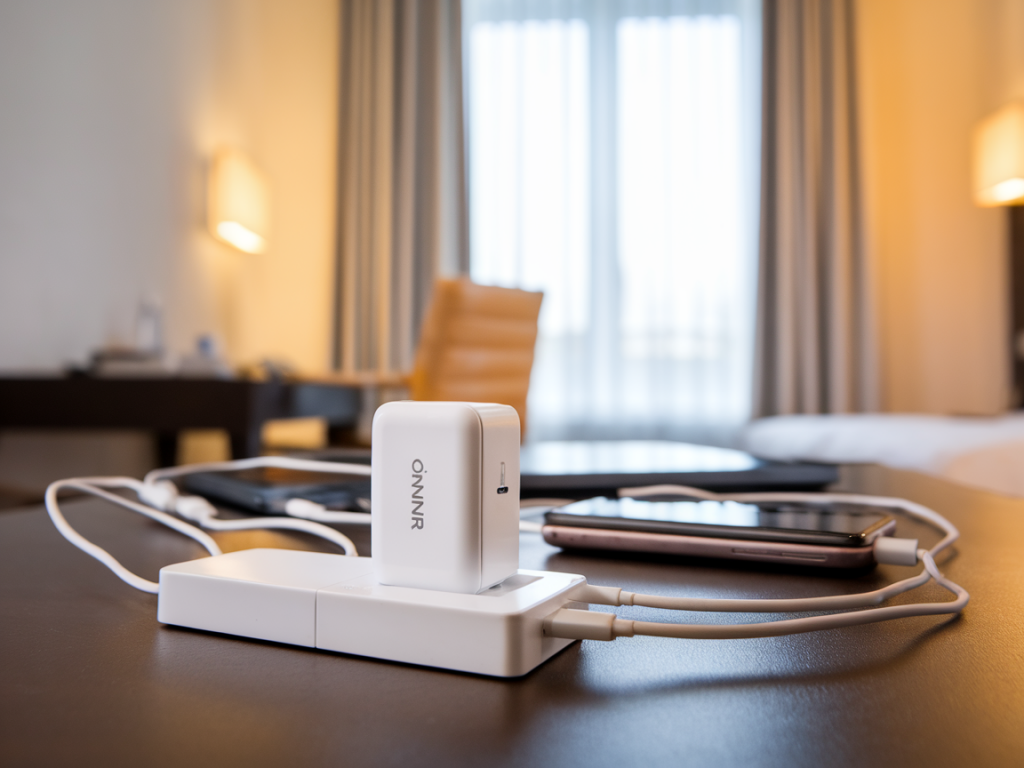
I recently spent a week traveling and living out of hotel rooms to test a question I keep seeing in comments and DMs: Can an Anker Nano really replace a hotel charging strip? I packed the Anker 511 Nano (20W) and the newer Anker Nano II (45W) into my tech pouch, alongside the usual suspects — iPhone, Android phone, iPad Mini, a pair of true wireless earbuds, an Apple Watch, and my 13-inch MacBook Air — and deliberately avoided bringing a full charging strip. The goal was practical: one tiny brick instead of a strip that clutters hotel desks and occupies a single wall socket. Here’s what I learned, device by device, plus the trade-offs you need to know before you decide to leave the strip at home.
Why people want to replace hotel strips
Hotel charging strips are convenient because they centralize outlets and sometimes offer extra USB ports. But they’re bulky, heavy, and some hotels frown on plugging strangers’ power strips into their outlets. I wanted to see if a compact USB-C charger like the Anker Nano could provide a cleaner, lighter travel solution without sacrificing the ability to charge multiple devices quickly.
What I tested (real-world setup)
My everyday travel kit for this test:
- Anker 511 Nano (20W USB-C)
- Anker Nano II 45W (with GaN and single USB-C PD)
- iPhone 14 Pro (MagSafe off)
- Samsung Galaxy S23
- iPad Mini (6th gen)
- 13" MacBook Air (M1)
- AirPods Pro 2
- Apple Watch Series 8
- Selection of USB-C and USB-A cables + a USB-C to USB-A adapter
Single-device performance: small bricks shine
When charging one device at a time, both Anker Nan o models delivered exactly what you’d expect. The 20W 511 Nano charged my iPhone 14 Pro from 20% to roughly 75% in an hour — fast enough for a quick top-up before heading out. The 45W Nano II handled my MacBook Air surprisingly well for basic productivity: it kept the laptop topped up during light browsing and restored battery after light sleep.
Key takeaway: For single-device charging (phone, tablet, or light laptop use), the Anker Nano units are compact, efficient, and generate less heat than many older chargers based on their GaN design.
Multiple devices at once: where the limitations appear
The real test was simultaneous charging. A hotel strip's biggest advantage is allowing several devices to charge at once — phones, laptop, watch, earbuds, and maybe a camera battery. With a single-port Anker Nano, you must daisy-chain solutions or use adapters. I tried a few real-world combos:
- Phone + AirPods (using phone’s USB-C and earbuds with Lightning/USB-C) — only one could draw full PD speed; the other had to rely on a lower-power cable or remain unpowered unless I used the phone as a power source through reverse charging, which isn’t practical.
- iPad + iPhone (through a USB-C hub that splits power) — hubs that split one PD input into multiple outputs rarely preserve full PD speeds; charging becomes slower for both devices.
- MacBook Air + phone — the 45W Nano II could keep the MacBook topped up and also charge a phone only if I used a small powered USB hub with PD passthrough, and even then the phone charged slowly.
Short version: a single USB-C Nano cannot replace the simultaneous-port convenience of a strip unless you accept slower charging on some devices or add extra dongles and hubs, which defeats the “minimal” goal.
Practical charge-times I recorded (approx.)
| Device | Charger | Observed 0–80% Time |
|---|---|---|
| iPhone 14 Pro | Anker 511 Nano (20W) | ~60 minutes |
| Samsung S23 | Anker Nano II (45W) | ~45 minutes (to 70%) |
| iPad Mini (USB-C) | Anker Nano II | ~90 minutes |
| MacBook Air (M1) | Anker Nano II (45W) | kept up during light use; 0–50% in ~90–100 minutes |
Heat, safety and hotel outlet realities
The GaN-based Anker Nano chargers ran cooler than older brick chargers, and I had no safety issues during the week. But there are things a strip sometimes provides that small USB bricks do not:
- Multiple AC sockets: Strips let you plug in non-USB devices (laptop power bricks, camera battery chargers, travel kettles). If you need to power AC-only devices, the Nano can’t help.
- Surge protection (varies): Some strips include surge protection. A small USB charger won’t protect other plugged-in AC devices if the hotel power surges.
- Outlets per room: Some hotels only have one convenient outlet; a strip obviously helps. But many modern hotels now offer a USB outlet or two by the desk/bedside.
Workarounds that sort-of keep things minimal
If you want to travel light but still ensure multiple devices charge, consider these options:
- Bring a multi-port USB-C PD charger (2–3 ports) instead of a single-port Nano. Anker and other brands offer compact 65W/45W 2–3 port chargers that still beat a strip on weight.
- Use a small USB-C hub with PD passthrough and dedicated USB-A ports — note that the total PD budget is shared among outputs.
- Prioritize charging: charge the laptop and phone overnight on the higher-power port, and top up accessories from battery cases or the phone during the day.
- Pack a tiny travel plug adapter that includes a few USB ports — often a good hybrid between strip and single-brick setups.
On convenience and cable clutter
One advantage I can’t overstate: ditching the strip means you carry fewer cables and get a neater bedside setup. The Anker Nano fits into any pocket and frees up desk space. For many short business trips where I only need to charge a phone and occasionally top up my AirPods, the Nano is liberating.
But if your travel pattern looks like: laptop + phone + smartwatch + earbuds every night, a single-port nano will frustrate you. You’ll be shuffling cables or waking up to partial charges.
Final practical recommendations
- If you mostly charge phones and an occasional tablet: a 20W or 45W Anker Nano is an excellent replacement for heavier chargers and a reasonable substitute for a strip in minimal setups.
- If you travel with a laptop and multiple USB devices nightly: go for a compact multi-port PD charger (45W+ with at least 2 ports) instead of a single-port Nano.
- If you absolutely must power AC-only gear or want true multi-socket convenience: keep a small hotel strip or a travel adapter with multiple outlets in your bag.
Overall, the Anker Nano is a brilliant travel companion when you want small and fast charging for one or two devices. It’s not a universal replacement for a hotel charging strip unless you adjust your expectations about simultaneous charging or add more travel gear that erodes the size advantage.