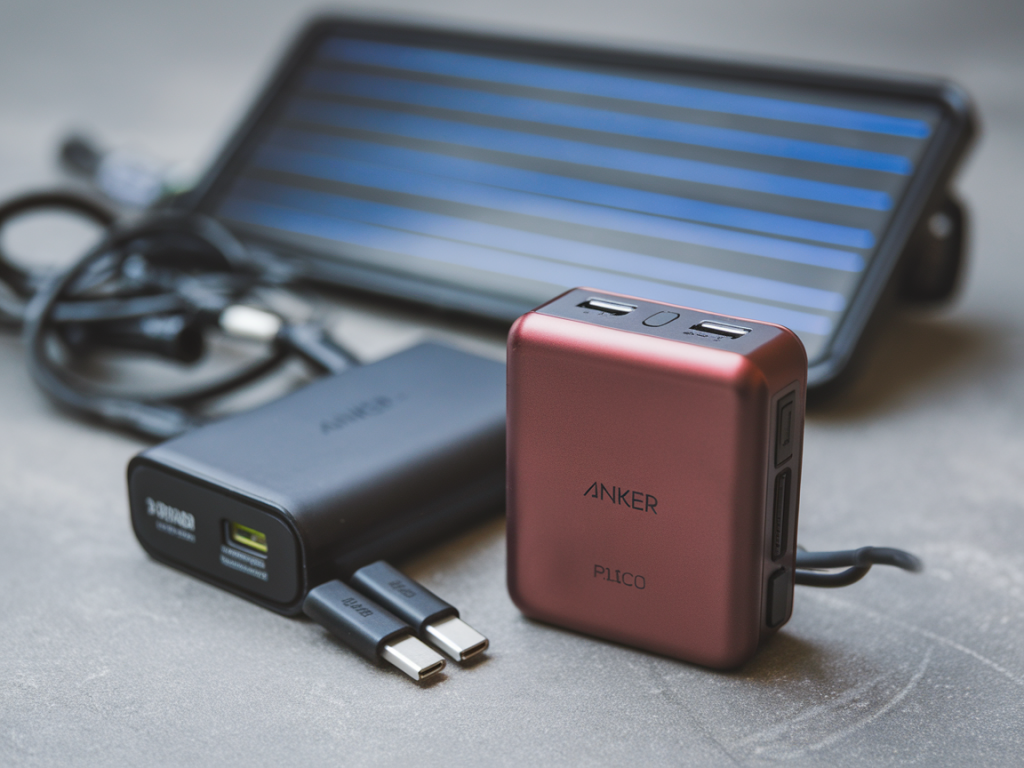
I keep a tiny emergency power kit in my bag at all times — it’s become my go-to for travel hiccups, long festival days, and those evenings when work runs late away from a plug. Over the years I refined what actually fits in a pocket or small pouch and still reliably revives phones, earbuds, and small devices. In this walkthrough I’ll show you how I build a compact kit around three practical components: an Anker Pico wall charger (the small GaN brick), a 10,000 mAh power bank, and a USB-C solar panel. I explain what I carry, why I chose each item, how to set it up, and tips to make the kit genuinely useful rather than just cute.
Why this trio?
There are two principles I stick to: size matters and real-world utility matters. A super high-capacity bank that can charge a laptop is useless if it won’t fit a coat pocket. Likewise, a tiny charger that refuses to fast-charge is only decorative. The Anker Pico charger gives me fast wall charging in a package that’s barely larger than a matchbox. A 10k power bank hits the sweet spot — enough capacity for a full phone top-up and more, yet small enough to slip into a pocket. The USB-C solar panel isn’t meant to fully power devices in a few hours, but it adds free emergency juice when you’re outdoors and away from sockets.
What I include in my pocketable kit
Here’s the compact set I typically carry. Everything fits into a small zip pouch or a dedicated phone sleeve.
How I choose each item
Choice comes down to a few simple checks I run whenever I buy accessories:
Quick spec comparison
| Item | Typical size | Practical output | Why I like it |
|---|---|---|---|
| Anker Pico 30W | ~42 x 42 x 28 mm | 30W USB-C PD | Very small, GaN efficiency, fast charge phone or top-up bank quickly |
| 10k mAh power bank | ~100 x 60 x 22 mm | USB-C PD 18–20W out, USB-C 18W in | Balance of capacity and pocketability, charges phone 1–2x |
| USB-C solar panel (10–15W) | folded: ~150 x 90 x 20 mm | 10–15W sunny peak | Lightweight emergency charging, folds flat into pouch |
Step-by-step setup and everyday workflow
Once everything is in your pouch, the routine becomes simple. Here’s how I use the kit depending on the situation.
Normal day — quick top-up: I keep the short USB-C cable in the pouch. If my phone dips under 30% during the day, I plug it into the 10k bank and continue working. If I have a socket nearby, I use the Anker Pico to recharge the power bank fast — an 18–20W PD input usually tops a 10k in around 2–3 hours, sometimes less depending on efficiency.
Travel day — airport delays: I prioritize charging the phone from the power bank while waiting. If I have a longer layover and a socket, the Pico charger gives a quick refill for both phone and bank. The compactness means I can move through security without worrying about a bulky brick.
Outdoor day — hiking or festival: I unfold the USB-C solar panel and aim it at the sun mid-morning. In direct sun, expect trickle charging — enough to keep an average phone alive or slowly top up the power bank. If I anticipate no sockets all day, I split use: reserve the power bank for emergencies and use the solar panel for low-power needs like earbuds or a fitness tracker.
Practical tips and trade-offs
A few real-life lessons I learned that change how I pack and use this kit:
Testing the kit — what I check before I trust it
I run a quick checklist after assembling the kit and after each firmware or accessory update:
Building a pocketable emergency power kit isn’t about buying the most expensive gear — it’s about selecting small, well-made components that play nicely together and suit your typical day. With a compact GaN charger like the Anker Pico, a PD-capable 10k power bank, and a foldable USB-C solar panel, you get a nimble, flexible system that covers most emergency and travel scenarios without weighing you down. If you want, I can list specific models I trust and where to find them within different budgets.