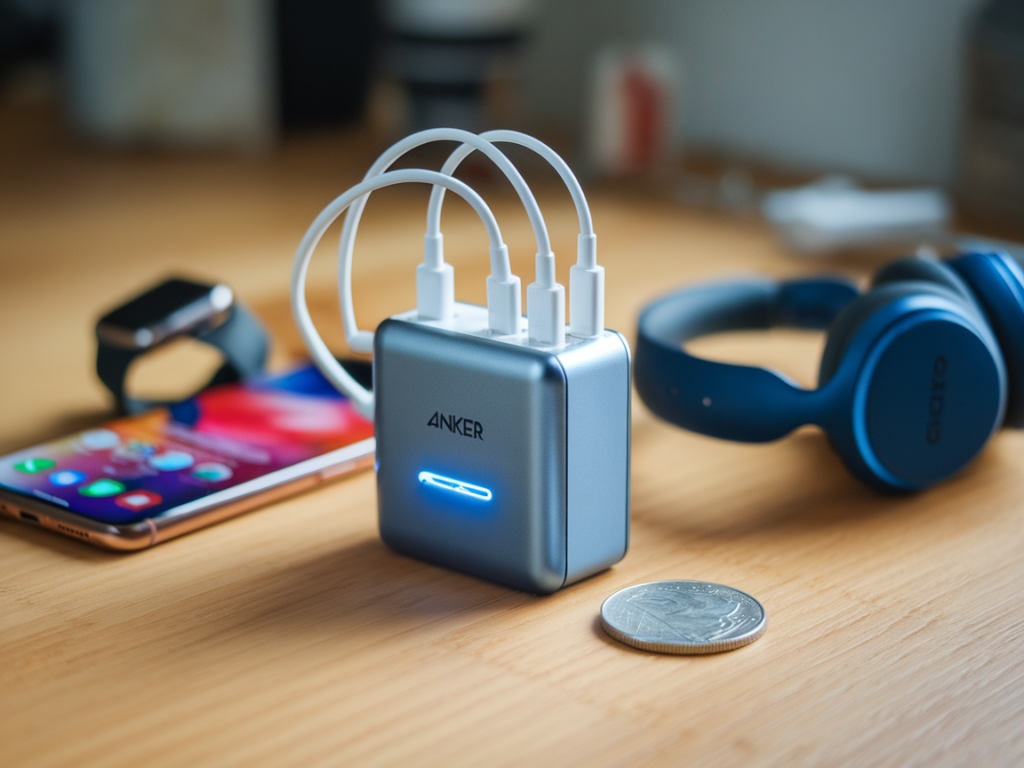
I travel a lot for work and pleasure, and over the years I’ve tried dozens of compact chargers. I’m picky about weight, bulk, and — most importantly — real-world charging performance. After running the Anker Nano through airport layovers, hotel rooms with flaky outlets, and the occasional café table with only one free socket, I’m convinced it deserves serious consideration as the best compact wall charger for frequent travelers.
Why size and power matter more than specs on paper
When I compare chargers, I don’t just look at watt numbers listed on the box. I care about how quickly a phone or laptop gets to a useful charge during a short wait, how hot the adapter runs on a long session, and how easy it is to carry with the rest of my gear. The original Anker Nano and its Nano II range use GaN (gallium nitride) to deliver useful power in a tiny package — and that’s the core advantage for travelers.
GaN lets manufacturers cram higher wattage into a smaller footprint without the heat and bulk of old silicon-based chargers. For me, that means a charger that fits in a pocket, won’t overheat in a crowded carry-on, and can quickly top up a phone or small laptop between meetings or flights.
What I tested and how I use the Anker Nano
I tested the Anker Nano 20W (the compact 20W USB‑C PD model) and compared it to a few close rivals: Apple 20W USB‑C, Anker Nano II 30W, and a couple of budget GaN chargers from Aukey and RAVPower. My routine included:
What stood out in daily use
Here’s what made the Anker Nano a keeper in my travel kit:
Where it outperforms rivals
Compared to the Apple 20W charger, the Anker Nano is smaller and often cheaper. Compared to budget GaN chargers, Anker tends to be more reliable and avoids the performance cliffs some cheaper units show when powering multiple devices or handling slightly higher wattage demands.
Caveats and when to choose a different charger
The standard Anker Nano 20W is great for phones and tablets, but if you regularly need to charge a 13-inch laptop at full speed you’ll want a higher-wattage unit (30–65W). The Nano II series addresses that with a 30W model that still stays compact and supports PPS (important for fast-charging many Android phones). If you need multiple ports for charging two devices at once, look at Anker’s two‑port GaN chargers or a small multiport PD hub.
Quick comparison table
| Model | Typical use | Wattage | Pros | Cons |
|---|---|---|---|---|
| Anker Nano (20W) | Phones, tablets | 20W | Very compact, good price, reliable | Not ideal for 13" laptops |
| Anker Nano II (30W) | Phones, tablets, light laptops | 30W | PPS support, still compact, faster for Android | Slightly bigger; still single port |
| Apple 20W | iPhone/iPad | 20W | Apple ecosystem compatibility | Larger than Anker Nano; pricier |
| Budget GaN 30W (generic) | Varied | 30W | Cheap, sometimes feature-rich | Variable quality; heating/throttling risk |
Packing tips for frequent travelers
From my experience, here are small tricks that make life easier:
Real-world scenarios where the Anker Nano shines
Here are a few everyday travel moments where the Nano makes a difference:
Final practical buying tips
If you’re deciding which Anker Nano to buy, here’s my quick advice:
The Anker Nano isn’t magic, but it hits the sweet spot of size, speed, and reliability that frequent travelers really care about. It’s the kind of accessory I leave in my daily carry without thinking twice — and when you travel as much as I do, that little bit of peace of mind goes a long way.