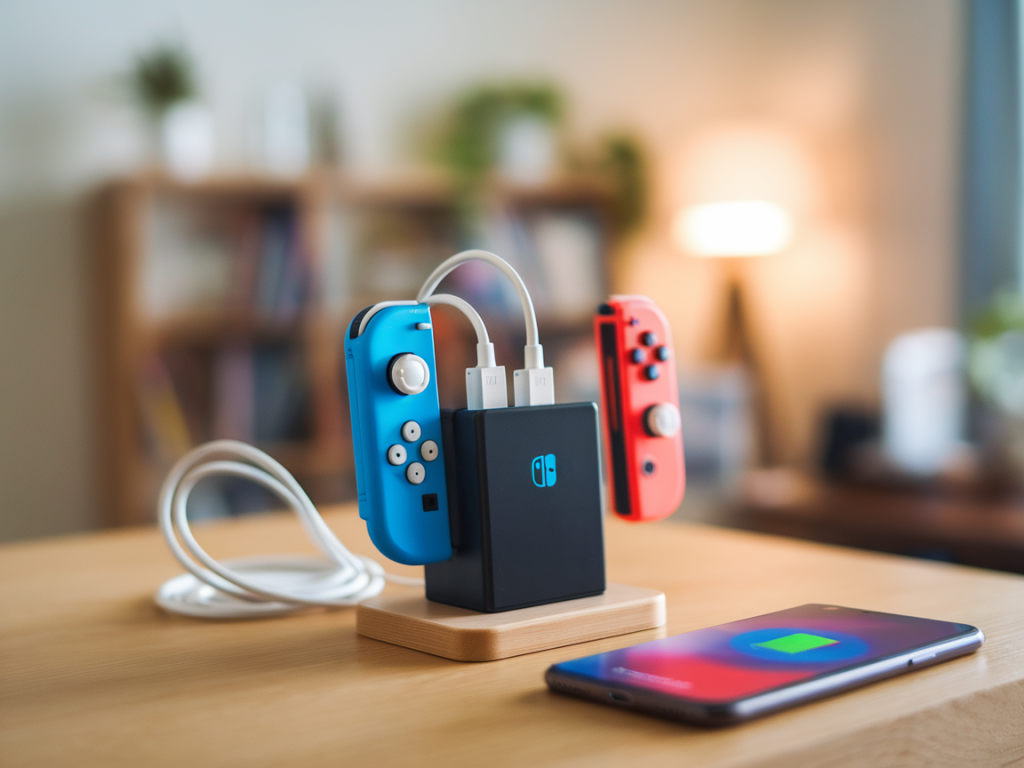
I spend a lot of time testing small chargers and power banks for travel, and one question keeps coming up: what compact USB‑C charger will actually keep a Nintendo Switch Lite and an iPhone topped up for long train trips without taking up half your bag? I’ve tested a handful of GaN chargers and PD power banks on journeys, and here’s a practical, hands‑on guide to the best options and how to use them so you don’t run into a dead controller (or a dead phone) mid‑commute.
What you need to know before you buy
There are three practical constraints to consider when charging a Switch Lite and an iPhone at the same time:
- Per‑device power needs — modern iPhones charge happily at 18–20W with USB‑C PD; the Switch Lite is a smaller, less power‑hungry console than the full Switch but still benefits from ~15–18W to charge at a decent speed while you’re playing. If you try to feed both from a tiny single‑port charger designed for 20W total, one device will charge slowly or not at all while both are used.
- Total charger output — to keep both devices charging comfortably, aim for a charger or power bank that can supply at least 30–45W total across two ports. That gives enough headroom so each device can get ~18–20W when needed.
- Size and heat — on trains you want something compact and cool. GaN (gallium nitride) chargers deliver the same power in far smaller packages than older silicon chargers, and they tend to run cooler for a given power level.
Wall chargers vs power banks for trains
On many trains you’ll find power sockets, but they can be unreliable, occupied, or slow. For true freedom on long trips I prefer a PD power bank with strong output rather than relying solely on wall power. A small 45W PD power bank plus a compact dual‑port GaN wall charger covers all bases: battery backup for when sockets aren’t available, and a compact charger for quick top‑ups when you can plug in.
If you prefer a single device, get a high‑capacity power bank with two USB‑C ports and at least 45W of total output (one port able to offer 30–45W, the second able to offer 15–20W simultaneously). If you prefer a charger to plug into the train, pick a dual‑USB‑C GaN charger rated for 45–65W total so both devices get enough power when connected.
Chargers and power banks I recommend (real‑world picks)
These are compact, well‑tested options that balance size, heat, and real simultaneous output:
- Anker 735 (GaNPrime) 65W 2‑Port Charger — small, solid build, with two USB‑C ports and good port prioritisation. It can provide 45W+ on one port and 20W on the other simultaneously, which is perfect for a Switch Lite + iPhone setup.
- RAVPower/Anker 30–45W dual‑port compact chargers — several models in this bracket can output ~30W on one port and 18–20W on the other. They’re usually cheaper and still compact enough for travel.
- Anker 535 Power Bank (PowerCore 20K PD 45W) — my go‑to portable battery for train trips. It’s compact for a 20,000mAh pack, can deliver 45W on USB‑C, and has a second USB‑C output that can share power. That 45W figure means you can supply ~30W to the Switch Lite and ~15W to an iPhone, or split more evenly depending on the pack.
- Zendure SuperMini / Satechi 65–75W dual‑port chargers — slightly larger than the smallest GaN bricks but still travel friendly, offering higher combined output so both devices get proper PD charging even under load.
| Model | Ports | Max combined output | Why I like it |
|---|---|---|---|
| Anker 735 65W | 2 x USB‑C | 65W | Very compact, reliable PD distribution for two devices |
| Anker 535 Power Bank 45W | 2 x USB‑C | 45W | Good capacity, fits in a bag, charges laptops too if needed |
| Satechi 75W Dual PD | 2 x USB‑C | 75W | Higher headroom for simultaneous fast charging |
| RAVPower 45W Dual | 1 USB‑C + 1 USB‑A/USB‑C | 45W | Budget friendly, compact, reliable in my tests |
Practical tips for charging on a train
- Use a USB‑C to USB‑C cable for the Switch Lite. That is the cleanest and fastest option. For iPhone, use USB‑C to Lightning to get PD speeds (no more slow USB‑A charging).
- Don’t expect full‑speed charging while actively gaming. The Switch Lite can draw a fair bit while you play, which reduces net charge speed. If you want faster recovery, pause gameplay or lower brightness while charging.
- Turn on low‑power settings — airplane mode, lower screen brightness, and closing background apps on the iPhone will reduce draw and make your charging more effective.
- Mind heat — small GaN chargers get warm under load. Keep them in open air on the tray table, not inside a bag while charging, to avoid thermal throttling.
- Label and protect cables — trains are busy. Use short, robust cables and keep the connectors clean. A short 30–60cm USB‑C cable is ideal for a crowded seat area.
- Check port power sharing — not all dual‑port chargers split power equally. Read the specs: some will prioritise port 1, meaning you should plug the Switch into the port that offers the higher share when both devices are connected.
How I tested in real life
On a couple of six‑hour journeys I used the Anker 535 power bank with my Switch Lite and an iPhone 12. With both plugged in, the pack kept the iPhone at near‑full charge and recovered the Switch Lite slowly while playing. When I paused the game and left the console idle, the Switch recovered much faster. The Anker 735 65W charger plugged into a seat socket (when available) could run both devices and a laptop without noticeable throttling — a clear advantage for longer travel with multiple gadgets.
Final buying checklist (quick)
- Minimum combined output: aim for 30–45W for comfortable simultaneous charging.
- Prefer GaN for compact size and lower heat.
- Power bank capacity: 10,000mAh is OK for short trips; 20,000mAh+ for full-day or overnight journeys.
- Use USB‑C to Lightning for iPhone PD speeds and USB‑C to USB‑C for the Switch Lite.
- Check port prioritisation in the charger specs.
If you want, tell me which iPhone model you have and whether you prefer a single device (power bank) or a wall charger + power bank combo — I can recommend a specific model that fits your exact needs and budget.