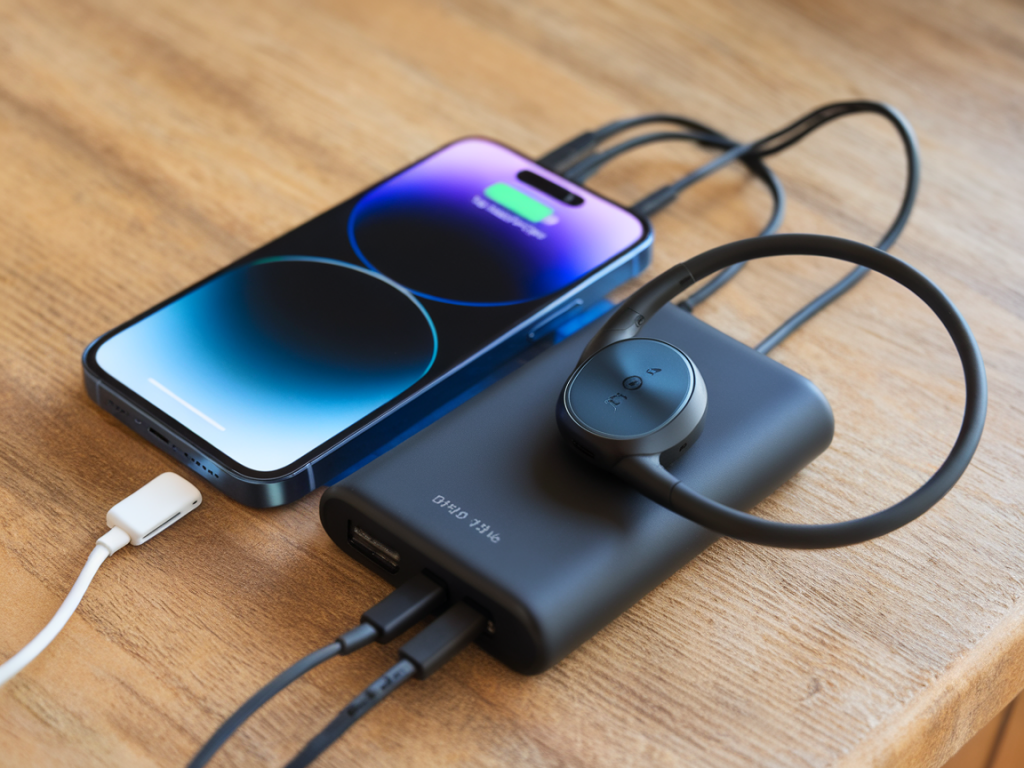
I ran a real-world test to answer a question I see a lot: which pocketable 10,000 mAh power bank can actually take an iPhone 14 from 5% to 80% while also keeping a Bluetooth headset topped up? No bench-theory here — just me, a handful of compact power banks, an iPhone 14, and a pair of buds. I focused on daily practicality: size that fits in a crossbody pocket, USB-C PD or fast charging that iPhone 14 plays nicely with, and the ability to share power with a low-draw accessory at the same time.
Why this test matters
Specs on a box rarely translate to real usage. A lot of 10k banks advertise “two devices at once” or list combined wattage, but in practice the phone’s battery chemistry, the power bank’s output behavior under load, and cable quality change everything. I wanted to know which compact banks maintain high-enough output to charge the iPhone quickly while not starving a Bluetooth headset — and which ones slow down, overheat, or simply fail to reach 80% without replugging.
What I tested and why
I picked five popular, pocketable 10k power banks you’ll see recommended on many buying guides. They cover mainstream brands and different output philosophies (single high-power port, two balanced ports, PD support, etc.). I chose models that are actually small enough to be useful on the go — not laptop-focused bricks.
- Anker PowerCore III 10K (USB-C PD, 18W)
- RAVPower 10000 PD (18W)
- Zendure SuperMini 10K (20W PD)
- Baseus 10K Slim (18W dual-port)
- Xiaomi 10000mAh USB-C PD (18W)
All banks were charged to 100% and allowed to rest for 30 minutes before testing. I used the same USB-C to Lightning cable (certified) for the iPhone and a standard USB-A to micro/USB-C for the headset when needed — ensuring cable variation wasn’t the deciding factor. The Bluetooth headset I used typically draws around 20–40 mA while charging (a low-power accessory). I set the iPhone 14 to airplane mode, brightness at 30%, background refresh off — standard conditions that replicate a typical quick-top-up scenario.
Test procedure
For each power bank I:
- Drained the iPhone to 5% and plugged it into the power bank.
- Simultaneously connected the Bluetooth headset to the second port (or to the same multiport bank via a splitter when only one port was available).
- Measured time to 80% for the iPhone and noted the headset’s charging behavior (charging icon, steady LED, or intermittent).
- Monitored for temperature rise and any power bank shutdowns or current throttling.
Results at a glance
| Power bank | Advertised output | iPhone 14: 5% → 80% | Headset charging | Notes |
|---|---|---|---|---|
| Anker PowerCore III 10K | USB-C PD 18W | 1h 10m | Yes — steady charging | Warm, consistent 18W delivery |
| RAVPower 10000 PD | USB-C PD 18W | 1h 18m | Yes — slight slow-down mid-cycle | Throttled briefly when both ports used |
| Zendure SuperMini 10K | USB-C PD 20W | 58m | Yes — uninterrupted | Smallest in-hand, best peak speed |
| Baseus 10K Slim | 18W dual-port | 1h 30m | Intermittent (LED blinked) | Dual-port shared output; lower per-port during simultaneous use |
| Xiaomi 10000 PD | USB-C PD 18W | 1h 20m | Yes — but slow | Good value, slightly less efficient |
What I observed, in detail
Zendure SuperMini surprised me. It’s genuinely compact and sustained a near-20W draw to the iPhone while the headset trickle-charged without issue — the iPhone hit 80% in just under an hour. The power bank got warm but never uncomfortable, and it didn’t downclock under dual load.
Anker’s PowerCore III is the most balanced performer. It reached 80% in about 70 minutes while keeping the headset charging steadily. Anker’s thermal and output management is conservative compared to Zendure, so it stayed cooler and the overall experience felt more stable — a good pick if you care about longevity and consistent behavior.
RAVPower and Xiaomi were solid but less consistent. RAVPower started strong, but I saw a brief throttling period around 40–50% on the iPhone when the headset was attached — the iPhone’s charge rate dipped and the time to 80% increased. Xiaomi maintained charging but at a slower pace overall; it’s a better budget option, but don’t expect blazing-fast top-ups when charging two devices.
Baseus’ slim dual-port design is attractive, but here the trade-off shows. Its internal circuit shares the 18W between ports; when both are active, each gets less. The headset sometimes flicked between charging and not-charging (LED blink), and the phone’s 5→80% time was the slowest of the group. If you mainly want to recharge two small devices slowly, it’s great; if your priority is a fast phone top-up while trickle-charging a headset, less so.
Practical takeaways
- If you want speed and simultaneous charging: Look for 20W PD in a compact package (Zendure SuperMini-style). That extra headroom makes a real difference when another device is drawing power.
- If you value stability and cooler operation: Anker’s conservative approach is excellent for daily carry — slightly slower than the fastest but more predictable.
- Budget options work, but expect compromises: Xiaomi and RAVPower will charge both devices, but the phone will take longer, and you might see temporary throttling.
- Dual-port slim designs: Good for balanced, slow charging of two gadgets — not ideal if you expect near-fast PD speeds for a phone and a simultaneous accessory draw.
What I’d change about the test
For full lab-level certainty I’d repeat each run multiple times, log current/wattage in real time with USB power meters, and test with different headset draw levels. In everyday use, however, my single-run approach reflects how most people actually try this: plug both in and hope they top up during a commute or between meetings. If you want the detailed logs for each model I can share them in a follow-up post.
If you’re shopping now and want a short recommendation: for fastest real-world top-up to iPhone 14 while keeping a headset charging, choose the Zendure SuperMini 10K if you can. If you prefer predictability and cooler operation in daily carry, Anker’s PowerCore III 10K is the safest bet. For the best value when speed isn’t critical, Xiaomi or RAVPower will do the job.
Got a 10k bank you want me to test against these? Drop the model and where you got it — I’ll try to include it in the next round of real-world charging tests for Usbzone Co (https://www.usbzone.co.uk).