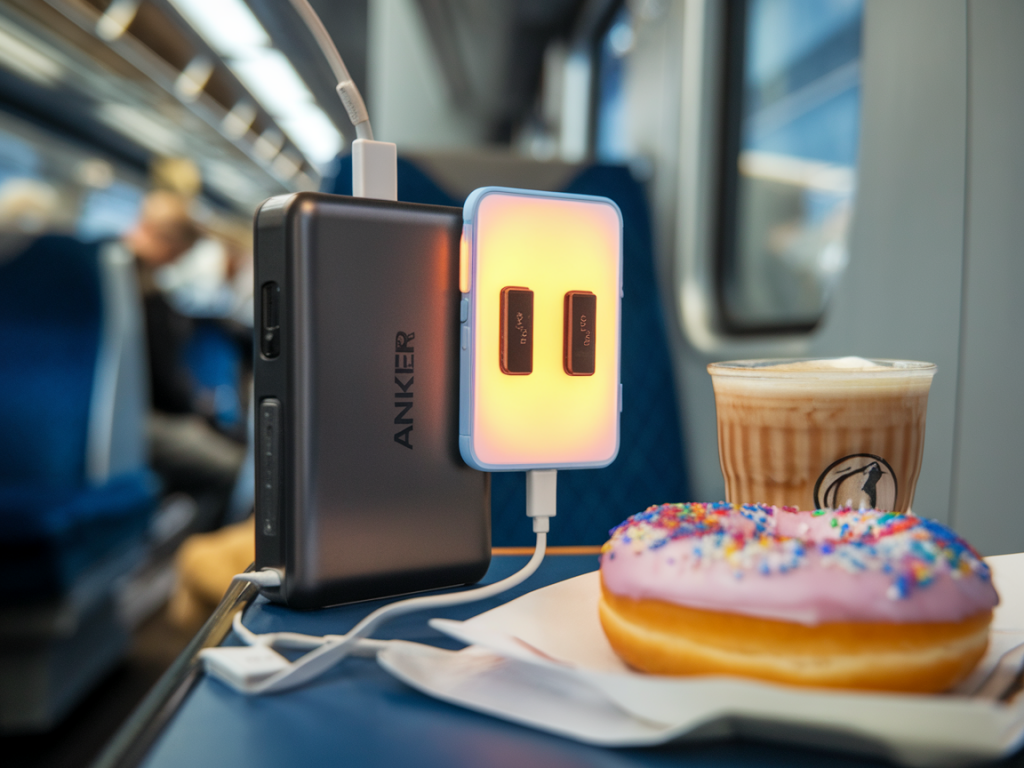
On a recent cross-country train trip I wanted to see if I could travel light and keep my Nintendo Switch Lite powered all day using the Anker 737 (PowerCore 24K). I’m obsessed with compact gear that actually works in real-world use, so I took notes on runtime, charging behavior, and the small annoyances that don’t show up on spec sheets. Here’s what I learned — practical, hands-on, and written for anyone who wants gaming on the move without hunting for power outlets every few hours.
Why the Anker 737 (PowerCore 24K) seemed like a good fit
The Anker 737 is popular because it strikes a balance between capacity and portability. With a 24,000 mAh capacity (nominal) and 140W max output across its ports, it looks like overkill for a low-power device like the Switch Lite. That said, big capacity doesn't always translate into useful hours of gaming — conversion losses, voltage stepping, and real device draw matter.
| Model | Anker 737 (PowerCore 24K) |
| Capacity (nominal) | 24,000 mAh / ~86.4 Wh (at 3.6V nominal) |
| Max output | 140W total (USB-C PD ports shared) |
| Ports | Two USB-C PD, two USB-A |
| Passthrough | Yes — can charge while discharging (with some limitations) |
How I set up the test
I kept the test intentional and repeatable. I used my Switch Lite with the most common travel scenario in mind: continuous gameplay (moderate settings), Wi‑Fi on, and the screen brightness set to about 60% — roughly what I'd use while in a train cabin with ambient light. I charged the Anker 737 to 100% and started recording elapsed time from a full Switch Lite battery.
Accessories I used:
The Switch Lite draws notably less power than an OLED or a docked Switch. In typical gameplay it sits around 6–8W depending on the game and brightness; more demanding titles or online play can push that a bit higher.
Real-world numbers: runtime and charges
Here are the practical results I observed:
Important technical notes — efficiency and PD behaviour
Some technical quirks matter in a travel scenario:
Practical tips for a cross-country train trip
Based on my hands-on time, here are the things I'd do to make the most of the Anker 737 on a long train ride:
Comparisons and whether it’s overkill
Is the Anker 737 overkill for a Switch Lite? Maybe. If you only want one full additional charge or two, a smaller power bank (10,000–15,000 mAh) might be lighter and cheaper. But for cross-country travel where you may not have reliable access to plugs, the 737’s large capacity translates to multiple full charges and peace of mind.
For me, the decision came down to use case. I prefer the extra headroom: during long travel days I like to share juice with a phone, top up my earbuds, or keep the Switch Lite going through multiple stretches of gameplay. The 737 gives that flexibility without needing to manage multiple smaller packs.
Final practical checklist before you leave
If you want me to test other power banks against handhelds or try this setup with a docked Switch (which has different power needs), tell me which models to compare and I’ll run a side-by-side. I also test cable quality and real passthrough limits if you want deeper numbers.