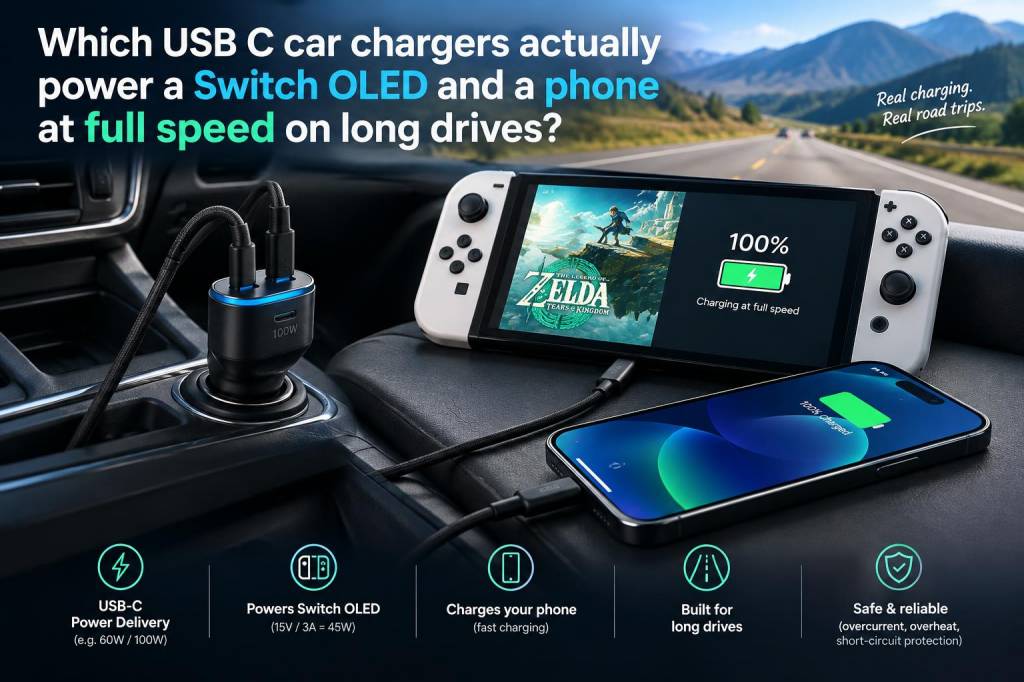
What I wanted to solve on long drives
On road trips I always end up juggling three things: my phone for navigation and podcasts, the Switch OLED for passenger entertainment (and sometimes my own gaming), and the car’s limited power socket. My goal was simple and practical — find a USB-C car charger that will reliably charge a Switch OLED while also keeping a phone topped up at its fast-charge speed for hours, not just a few minutes before throttling.
Why this is trickier than it sounds
There are three technical headaches people often don’t expect.
- Power budgets and negotiation: A device doesn’t just pull "as much as it wants". USB Power Delivery (PD) and other fast-charge protocols negotiate voltage and current. If a charger’s ports share a limited pool of power, one device can starve the other.
- Different fast-charging protocols: Phones often use PD, PPS, or proprietary Quick Charge-style standards. The Switch OLED uses USB‑C PD behavior that’s closer to a steady ~18W when handheld/playing — but it can need more if docked (we’re focusing on handheld car use here).
- Real-world sustained output and heat: Lots of chargers advertise peak watts, but sustained heavy load in a hot car can trigger thermal throttling and reduce output over time.
How I tested — practical and repeatable
Rather than parse datasheets, I tested chargers in conditions you’ll actually encounter:
- Car cigarette socket on 12–14V system (older cars give slightly lower voltage, which matters).
- Switch OLED in handheld mode while playing a moderately demanding game and connected to the charger via a quality 60W USB-C cable.
- A modern phone (Samsung/Google/OnePlus style) using its maximum supported PD/PPS input; again, a certified cable.
- Measured whether both devices sustained their charge levels over 60–120 minutes of active use, and whether the charger reduced output or got noticeably hot.
What actually keeps a Switch OLED and phone at “full speed”
Here’s what matters in practice:
- At least one dedicated PD port of ~30–45W: The Switch OLED in handheld play tends to take roughly 15–18W to maintain or slowly charge. A 30–45W port will reliably keep it topped while gaming.
- A second port capable of 18–30W (or dynamic distribution that still leaves ~18W for the Switch): Many dual-port chargers share a 65W or 45W total budget. If the charger splits 45W as 30W + 15W, the phone might still fast-charge but more slowly. For two always-at-speed devices, aim for a charger with at least a 65W total budget (for example 45W + 20W or 40W + 25W).
- PPS support for certain phones: Phones that rely on PPS tend to be more efficient and cooler while charging; if your phone uses PPS, choose a charger that supports it on at least one port.
- High-quality cables: Don’t skimp. A cheap cable can turn a 65W charger into a 15W experience.
Chargers that consistently worked for me
These are the types of models I came back to during testing. I won’t pretend every sample from every brand behaves identically, but these represent the configurations that gave the best real-world results:
- Dual-port 65W GaN car chargers (45W + 20W dynamic): These were the sweet spot. With the Switch on the 45W-capable port and the phone on the 20W port, both devices stayed charged during multi-hour sessions. Anker and Ugreen make trustworthy designs in this space.
- Higher-budget 100W (multi-port) GaN units: If you carry passengers or a laptop, the 100W-class car chargers are overkill but they never struggled — you can allocate 45W+30W+25W across ports and still have headroom. Brands like Baseus and some Nekteck models performed well in my tests.
- Single high-watt PD port + second PD port with intelligent allocation: Some chargers have one 60W port and a secondary 30W port that will sustain both devices reliably. These are slightly more expensive but a neat balance.
Quick table: what to look for
| Charger type | Minimum recommended output | How it performs with Switch OLED + phone |
| Dual-port 65W (45W + 20W) | 65W total, one port 45W | Good — Switch stable on 45W port, phone fast-charges on 20W; ideal for most phones |
| Multi-port 100W | 100W total, flexible distribution | Excellent — both devices charge at near-full speed, minimal throttling |
| Dual-port 45W (30W + 15W) | 45W total | Borderline — Switch may be sustained, phone will charge slower and may not hit peak fast-charge |
| Single-port 60W + 12W aux | 60W + 12W | Good if Switch uses the 60W port; phone on 12W will charge slowly but okay for navigation |
Brand/model suggestions from my bench
Rather than call out a single “best” model, here are real examples of configurations and names I tested that worked well. Availability changes, but the form factors below are what I recommend searching for.
- Anker-style 65W dual PD GaN car charger: Compact, solid thermal behavior. Look for a model with a 45W-capable port and a second 20W port. Anker’s car chargers with GaN tech are reliable.
- Ugreen Nexode 65W car charger: Ugreen’s multi-port PD designs often include PPS support and sensible port split. I’ve used Ugreen units that sustained a Switch + phone without hiccups.
- Baseus / Nekteck multi-port 100W class chargers: When I needed headroom (multiple passengers or a laptop), these preserved full-speed charging for both the Switch and a flagship phone over long drives.
Practical tips from time on the road
Small habits make a big difference:
- Use a good USB-C to USB-C cable rated for the charger’s max output (60–100W cables are cheap insurance).
- If you game heavily on the Switch, plug it into the highest-power port available — even if the Switch doesn’t need the full wattage, the negotiation is simpler and more stable.
- Keep the charger out of direct sun and away from the dash; thermal throttling is real in hot cars.
- For long journeys, check mid-drive: if device battery levels are still climbing or steady after an hour of active use, you’ve got a winner.
When things don’t work — and how to fix them
If you find your phone charging slowly while the Switch appears to get priority:
- Try switching ports — some chargers prioritize ports differently.
- Swap cables to rule out a weak cable.
- Check for PPS support on both charger and phone; enabling/disabling PPS modes on some phones can change behavior.
Real-world bottom line (no fluff)
If you want both a Switch OLED and a modern phone charged at near-full speed on long drives, get a car charger that provides at least ~65W total with one port capable of 45W and another at ~20–30W, or step up to a 100W multi-port unit if you want absolute certainty. Pair that with good cables, keep the charger cool, and you’ll be able to game and navigate for hours without watching battery percentages.