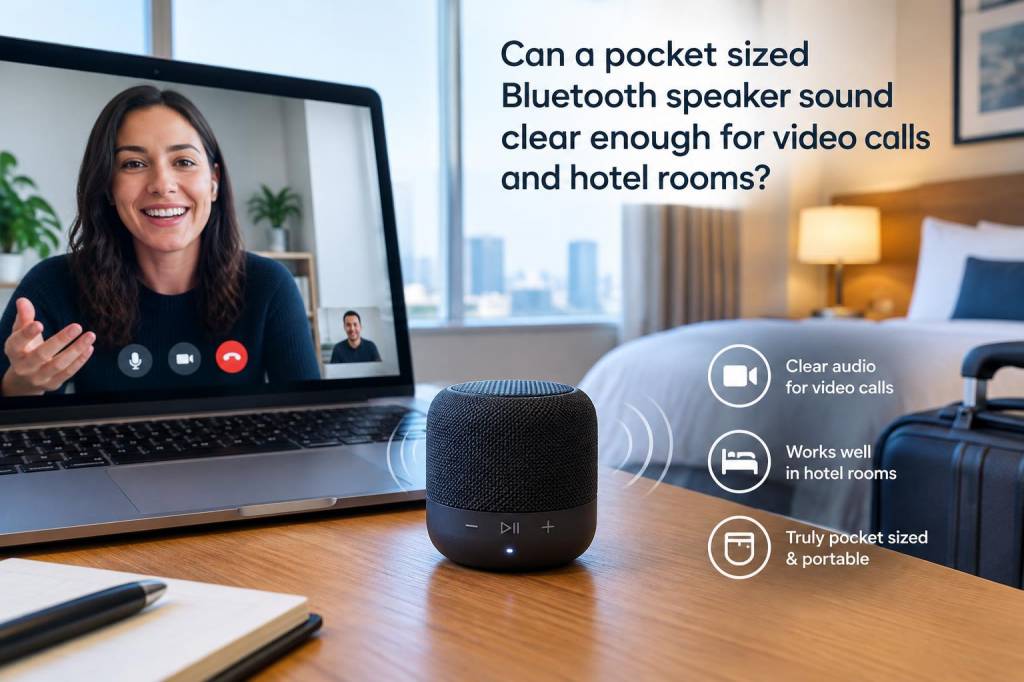
I have spent enough time with tiny speakers to know that size alone does not tell the full story. A pocket-sized Bluetooth speaker can surprise you in a hotel room, and it can also disappoint you during a video call if its microphone, tuning, or connection quality is weak. So when people ask me whether a small speaker can sound clear enough for calls and travel use, my answer is usually: yes, but only if you choose carefully and use it in realistic conditions.
I have tested compact speakers in offices, kitchens, hotel rooms, and temporary work setups, and I keep coming back to one simple truth: clarity matters more than volume. A tiny speaker does not need to shake furniture. It needs to keep voices intelligible, avoid harsh treble, and stay stable when paired with a phone, tablet, or laptop. If it can do that, it becomes much more useful than many people expect.
What “clear enough” really means
For video calls, “clear enough” is not about audiophile performance. It means I can understand voices without strain, notice tone changes, and avoid the fatigue that comes from thin, brittle sound. In a hotel room, it means spoken content stays focused and not muddy, even if I am watching a meeting replay, listening to a podcast, or joining a late-night call when I do not want to use built-in laptop speakers.
When I judge a pocket speaker, I listen for a few practical things:
- Voice clarity during speech-heavy content
- Stable Bluetooth connection without dropouts or delay
- Balanced midrange so voices do not sound buried
- Enough output to fill a small room without distortion
- Controlled bass so low end does not mask speech
That last point is important. Many tiny speakers try to impress with bass, but too much low end can make voices blur together. For calls, I usually prefer a speaker that sounds a little restrained rather than one that sounds exaggerated.
Why small speakers can work surprisingly well
Small speakers have a natural advantage in one area: direct sound. When a speaker is compact and placed near me, especially on a desk or bedside table, the sound reaches my ears quickly and without much room echo. In a hotel room, that often helps more than raw power. A large speaker can sound impressive but overkill, while a smaller one can sound more focused and easier to understand.
I also like compact speakers for travel because they are easy to position. I can move one closer to my laptop during a meeting, set it on a nightstand for a movie, or carry it from room to room without thinking about cables. That flexibility matters more than people expect. If a speaker is awkward to place, I use it less, no matter how good it sounds on paper.
In my experience, many of the better pocket speakers from brands like JBL, Anker Soundcore, Sony, and Ultimate Ears manage a decent balance of size and clarity. Some are not perfect for music, but they are excellent for speech. That distinction is easy to miss when reading product specs, yet it is central to real use.
Where pocket speakers fall short
I would not use a very small Bluetooth speaker as a universal replacement for every audio task. In larger rooms, especially spaces with hard surfaces, the sound can become boxy or overly bright. If I place it too far away, voices lose presence. If the room is noisy, a tiny speaker may struggle to compete with air conditioning, hallway noise, or traffic outside a window.
Microphone quality is another weak point. Some compact speakers include speakerphone support, but not all of them are good at it. A speaker might play audio clearly while still picking up my voice poorly. If I plan to speak often during calls, I pay close attention to microphone performance, not just playback sound. A speakerphone feature sounds useful, but I have learned not to assume it will be good enough for important meetings.
Battery life can also affect clarity indirectly. As a battery drains, some devices reduce output or change tonal balance. I have noticed that a speaker that sounds open and clean at full charge can feel flatter late in the day. That does not happen with every model, but it is something I keep in mind during travel.
What I look for when I want one speaker for calls and hotels
If I want one compact speaker to handle both video calls and hotel-room listening, I focus on a short list of practical features rather than flashy marketing language.
- Dedicated voice or speech mode if available, since it often improves midrange focus
- Low latency for lip sync during video playback and meetings
- Multipoint pairing if I want to switch between laptop and phone without hassle
- Physical buttons that are easy to use in the dark
- USB-C charging for easier packing and fewer extra cables
- Decent driver size and passive radiator design when available in a small enclosure
I also pay attention to whether a speaker sits securely on a table. A tiny unit with a slippery base may slide around during vibrations or when I adjust volume. That sounds minor, but in a hotel room or on a narrow desk, it becomes annoying fast.
My real-world expectations for video calls
For video calls, I prefer to think of a pocket speaker as a listener-side upgrade first. If I am receiving audio from meetings, online classes, interviews, or client calls, a compact speaker can make voices easier to understand than laptop speakers. This is especially true when the laptop speakers point away from me or sound tinny at low volume.
For speaking, I am more cautious. If the speaker includes a usable built-in mic, I may try it in a quiet room. If I am in a noisy environment, I usually still choose the laptop microphone, earbuds, or a headset. That is because microphone pickup from a tiny speaker can be inconsistent, especially if the unit is placed farther than arm’s length away.
When I test speakerphone quality, I ask myself three questions:
- Do people on the other end understand my voice easily?
- Does the speaker reduce echo enough for casual conversation?
- Can I hear my own voice naturally enough to avoid talking too loudly?
If all three are yes, I consider the speaker usable for casual calls. If only one or two are yes, I treat speakerphone support as a backup feature rather than a main reason to buy.
What changes in a hotel room
A hotel room can be a very friendly acoustic environment for a small speaker, but only if I use it well. Carpets, curtains, bedding, and soft furniture help absorb reflections, which makes speech sound cleaner. In a room with a hard desk, tiled bathroom, or bare walls, sound can bounce more and become harsher. That is why placement matters so much.
I usually place a compact speaker on a bedside table, desk, or luggage bench rather than on a soft bed or deep carpet. A stable, hard surface helps bass stay cleaner and keeps the sound from becoming muffled. If the speaker has a strap or loop, I sometimes angle it slightly toward me rather than letting it fire straight into the room.
Hotel use also changes my volume habits. I rarely need a tiny speaker at maximum output. In fact, pushing it too hard can reduce clarity and make voices rougher. A good compact speaker should sound strongest in the middle range, where speech still feels natural and open.
Compact models that usually make sense
I have seen a few product types perform especially well in this category. Ultra-small models are convenient, but some slightly larger pocket speakers are actually better because they give the drivers more room to breathe. That extra space can improve midrange clarity and reduce distortion.
When I compare options, I often look at models such as:
- JBL Clip series units for travel-friendly portability
- Anker Soundcore compact speakers for strong value and simple controls
- Sony portable speakers when I want a more polished voice presentation
- Ultimate Ears models when durability and all-around convenience matter
I am not saying every model from these brands is ideal for every use case. What I am saying is that these lines often include compact options with enough refinement to make speech sound presentable. If I were buying mainly for music, I might judge them differently. For calls and hotel listening, clarity and convenience often matter more than bass depth.
Where a pocket speaker beats earbuds
I still use earbuds often, but there are situations where a tiny speaker feels better. During long work sessions, I enjoy not having something in or on my ears. If I am alone in a hotel room, a small speaker lets me listen comfortably while charging my phone, taking notes, or moving around the room.
I also find speakers easier for shared listening. If I am traveling with a colleague or partner, a pocket speaker lets both of us hear the same call or video without passing a device back and forth. That is useful for quick planning sessions, travel updates, or casual entertainment.
Another benefit is comfort. After a long flight, I often want fewer things attached to me, not more. A small speaker can be a more relaxed choice for an evening call or a quiet podcast session before sleep.
A quick comparison I use in my head
| Use case | Pocket speaker | Earbuds | Laptop speakers |
|---|---|---|---|
| Video call listening | Very good in quiet rooms | Excellent | Often weak |
| Speaking during calls | Mixed, depends on mic quality | Usually very good | Usually usable |
| Hotel-room media | Very convenient | Private, but less shared | Often too thin |
| Travel convenience | Excellent | Excellent | Poor |
| Room-filling sound | Limited | Not relevant | Limited |
This comparison is why I do not treat a pocket Bluetooth speaker as a gimmick. It can be the right tool in the right setting. I just do not expect it to do everything.
What I would tell a friend before buying one
If a friend asked me whether a pocket-sized Bluetooth speaker can sound clear enough for video calls and hotel rooms, I would say yes, provided they are realistic about room size, volume, and microphone quality. I would tell them to prioritize voice clarity over bass, choose a model with stable Bluetooth and easy controls, and avoid assuming every speakerphone feature is equally good.
I would also suggest testing placement before judging the sound. A tiny speaker can go from average to surprisingly useful with a simple change in angle or distance. In a hotel room, that difference can be enough to make a late-night meeting, a movie, or a podcast feel much more comfortable.
Most of all, I have learned not to dismiss small audio gear just because it looks modest. A pocket-sized Bluetooth speaker will not replace every larger speaker or every good headset, but in the right setting it can sound cleaner, more relaxed, and more practical than many people expect.