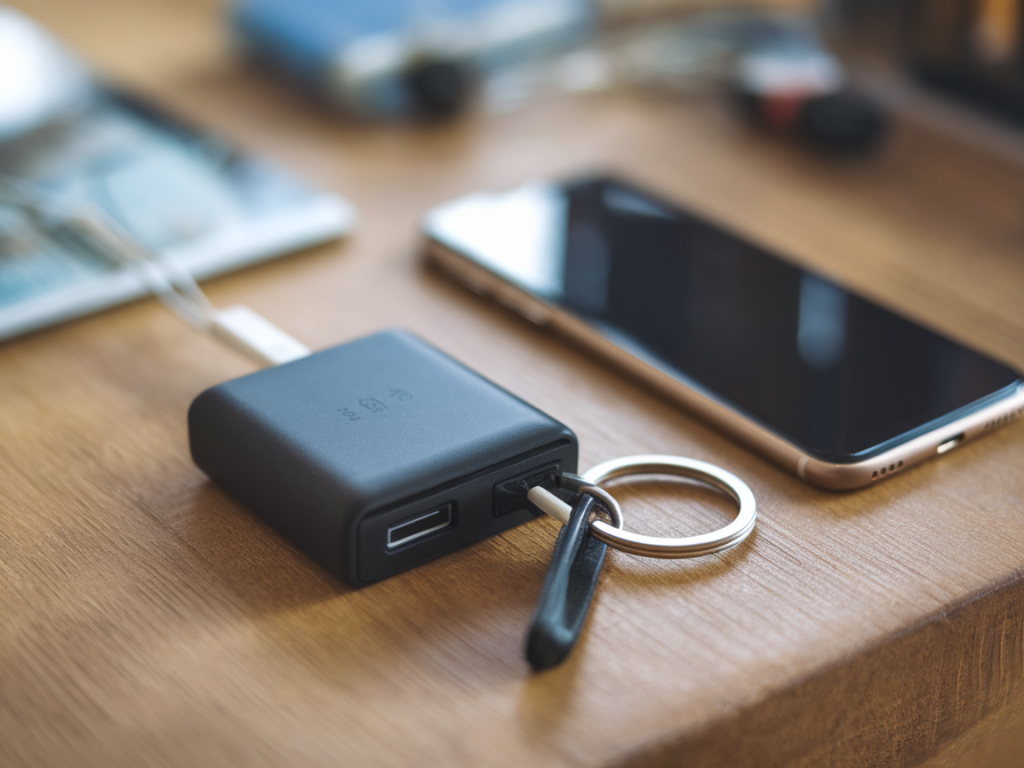
I love the idea of a tiny power bank clipped to my keys — something I can forget about until my phone dips below 20% and then voilà, two top-ups on the go. In practice, fitting enough battery to charge a modern phone twice into a true keyring-sized package is a balancing act between capacity, size, weight and charging speed. Below I walk you through the practical choices I make when hunting for a pocket power bank that actually delivers two charges and still hangs on my keyring without feeling like a brick.
Start with real numbers: how much capacity do you actually need?
Phones today typically have batteries between 3000 mAh and 5000 mAh. But you can’t directly equate phone mAh to power bank mAh because of conversion losses and voltage differences. A conservative rule of thumb:
That means, if you want two near-full charges for many mid-sized phones, aim for a power bank with a nominal capacity of roughly 10,000–12,000 mAh. If your phone has a smaller battery (e.g., 2500–3000 mAh), a 6,000–8,000 mAh pack may do two smaller charges. For compactness, many keyring-focused models compress nearer to 5,000 mAh — which often gives 1 to 1.5 charges.
Size vs capacity trade-off
If “fits your keyring” is non-negotiable, accept some limits. True keychain chargers — tiny cylindrical or flat tags — usually sit in the 2,000–5,000 mAh range. To actually get two charges, I look for the smallest 7,000–10,000 mAh packs that use smart packaging: flat rectangular or pill-shaped bodies that can be looped onto a carabiner or a sturdy split ring.
Consider weight, too: every extra 1,000 mAh roughly adds 30–60 g depending on cell density and case. A 10,000 mAh power bank may weigh 180–250 g — still pocketable but not keychain-light. Decide whether you want to hang it on your everyday keys or keep it clipped to a bag strap.
Output and charging speed — what matters in real life
Charging speed affects how practical that “two charges” promise is. Key points I check:
Small keyring-friendly power banks often sacrifice fast charging to stay compact. If you need speed (e.g., to get from 10% to 50% quickly during a commute), prioritise models with at least 12W–18W output and USB-C PD support.
Connector type and cable management
I prefer power banks with an integrated cable or a dedicated short cable that tucks into the body. Tiny packs that require you to carry a separate cable are less convenient for keyring use. Decide which connector you need:
If you absolutely need a keyring-sized device that works with multiple phones, choose one with a retractable cable or attach a small multi-tip cable to your keyring.
Battery type and safety
Most pocket power banks use Li-ion (lithium-ion) or Li-poly (lithium-polymer) cells. Li-poly can allow slimmer shapes and slightly better energy density, which is why many compact models use it. Safety features I won’t compromise on:
Buy from reputable brands (Anker, Zendure, RAVPower, Nitecore and similar) that publish safety certifications. Avoid anonymous ultra-cheap packs without specs or safety info.
Durability, attachment and daily use
If it’s on my keys, a power bank needs to survive being jostled, dropped or tossed into a bag. Look for:
Some compact models are designed specifically as keychain chargers with reinforced split-ring attachments or a small carabiner included. These are worth the extra few grams for peace of mind.
Useful features: passthrough, indicator lights, and smart charging
Passthrough charging (charging the power bank while it charges your phone) can be handy in a pinch but sometimes stresses the battery. I don’t make passthrough a must-have, but I appreciate:
How I choose in practice — a short checklist
When I’m shopping, I mentally run through this checklist:
Quick comparison table
| Feature | What to look for | Why it matters |
|---|---|---|
| Capacity | 10,000–12,000 mAh for two full mid-size charges | Covers two charges accounting for conversion losses |
| Output | USB-C PD or 12–18W | Faster recharges and more practical top-ups |
| Form factor | Flat or pill-shaped with solid attachment | Fits keyring or clip without too much bulk |
| Cable | Integrated or stowable short cable | No extra cable to remember |
| Safety | Certifications, overcurrent/temperature protection | Prevents device damage and fire risk |
Brands and models worth checking
There are many reputable options. In my experience, brands like Anker, Zendure, Nitecore and RAVPower tend to balance safety and real-world performance. If you want a true keyring form factor, look at models explicitly marketed as keychain chargers — they usually prioritise attachment and protection. If you need two full charges and you're willing to accept a slightly heavier item, a compact 10,000 mAh unit from those brands is often the sweet spot.
If you want help picking a specific model based on your phone model, how you carry your keys, and whether you prioritise speed or weight, tell me your phone and how small you want the pack to be and I’ll recommend a shortlist that fits your needs.